How to Declutter a Small Closet in One Weekend (Step by Step)
Learn how to declutter a small closet in one weekend: empty it, sort it, use the hanger trick and add vertical storage. Start Saturday morning!
In this article
- How to Declutter a Small Closet: Your Weekend Plan
- Step 1: Empty the Closet Completely
- Step 2: Sort Into Keep, Donate, Sell and Toss
- Step 3: Hang What’s Left With the Hanger Trick
- Step 4: Set Up Zones So Everything Has a Home
- Small-Space Hacks: Use Vertical Space
- If Your Closet Still Feels Full
- Keep It Decluttered Without Extra Work
- Your Next Step
The door barely closes, three hangers slide off the rail every time you grab a shirt, and you still can’t find the sweater you want. The good news: you can declutter a small closet in a single weekend, with about five hours of real work and no new furniture. This plan covers emptying, sorting, hanging and adding storage in the order that makes each step easier.
Key takeaways
- Empty the whole closet first. You can’t judge what you own while it hides on a packed rail.
- Sort into four piles only: keep, donate, sell and toss. Decide in seconds, not minutes.
- Flip every hanger backward (the hanger trick) and let your own habits show what you really wear.
- Group what you keep into zones by how often you use it, with everyday clothes at eye level.
- Slim hangers, an over-the-door organizer and hanging baskets add room without drilling. Buy storage last.
How to Declutter a Small Closet: Your Weekend Plan
Splitting the job across two days keeps it from feeling like a marathon. Saturday is for decisions (empty, sort, bag). Sunday is for putting things back in a smarter way.
| When | Task | Time |
|---|---|---|
| Saturday morning | Empty the closet and wipe it down | 45 min |
| Saturday morning | Sort into keep, donate, sell and toss | 90 min |
| Saturday afternoon | Bag donations, photograph items to sell, take out the trash | 45 min |
| Sunday morning | Measure, set up zones, hang with the hanger trick | 60 min |
| Sunday afternoon | Add vertical storage and put everything back | 60-90 min |
Before you start, gather four boxes or bags and label them Keep, Donate, Sell and Toss. Add a trash bag, a damp cloth, a tape measure and a phone timer. That’s all the gear you need.
Step 1: Empty the Closet Completely
Take out everything: every hanger, shoe, bag and box on the shelf. Pile it on the bed or the floor. A heap on the bed shows you how much you own in a way a packed rail never will, and it makes it impossible to skip the forgotten corners.
While the closet is empty, spend ten minutes on the space itself:
- Vacuum the floor and corners, then wipe the shelf and rod with a damp cloth.
- Look for tiny holes in wool and knit pieces, a sign of moth damage.
- Measure the width, depth and rod height, and jot them in your phone. You’ll need these numbers on Sunday.
Did you know?
Clothes moth damage comes from the larvae, not the flying adults. The larvae feed on keratin in wool, cashmere, silk and fur, and they prefer fabric with sweat or food stains. Washing or dry cleaning items before you store them is one of the most effective defenses.
Step 2: Sort Into Keep, Donate, Sell and Toss
Set your timer and pick up each item once. Give it about ten seconds. If you start debating, use the table below. Start with the easy calls, like torn or stained pieces, to build momentum before you reach the tricky ones.
The Keep-or-Let-Go Decision Table
| If this is true… | Do this |
|---|---|
| You wore it in the past year (or wear it every season) | Keep |
| It fits and you like it, but you can’t build one outfit around it in five minutes | Donate or sell |
| It doesn’t fit and probably won’t within three months | Donate or sell |
| It needs a repair that has been waiting for three months or more | Fix it this week, or donate |
| You own three or more near-duplicates (the fourth black tee) | Keep the best one or two |
| It’s a good brand, or it still has tags | Sell |
| It’s stained, ripped or pilled beyond saving | Toss |
| It’s sentimental but never worn | Photograph it, keep one small memory box |
Why letting go feels hard
In a classic 1990 experiment by economists Daniel Kahneman, Jack Knetsch and Richard Thaler, people who were given a coffee mug asked for about twice as much to sell it as other people were willing to pay for it. Researchers call this the endowment effect: we value things more simply because they’re ours. If a sweater is hard to part with, that’s normal.
For anything you truly can’t decide on, allow yourself one “maybe” box. Write today’s date on it and tape it shut. If you haven’t opened it within 60 days, donate it without looking inside.
Where Each Pile Goes
- Donate: Bag it and put it in your car right away so it actually leaves the house. Ask for a receipt at drop-off.
- Sell: Photograph each piece on a hanger in daylight and list it within a week. Anything unsold after two weeks goes in the donate bag.
- Toss: Worn-out cotton tees make good cleaning rags. Otherwise, check whether your city or a clothing retailer takes worn textiles for recycling.
Textile waste is huge
The EPA estimates that Americans generated about 17 million tons of textile waste in 2018, and more than 11 million tons ended up in landfills. See the EPA’s textiles data for the full breakdown.
Step 3: Hang What’s Left With the Hanger Trick
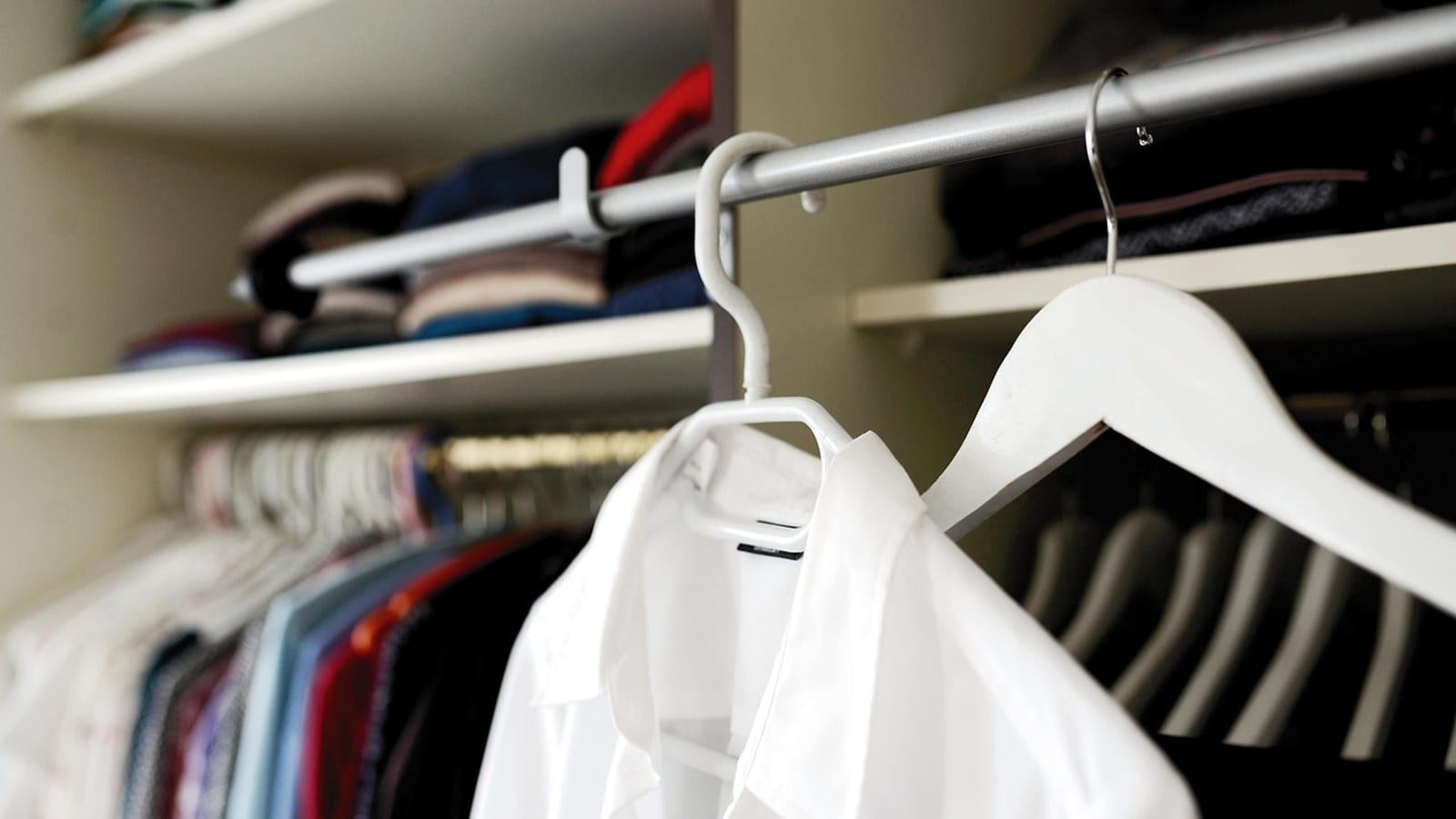
You have your keep pile. Now let it prove itself. Hang every item with the hanger turned backward, so the hook faces you instead of the wall. After you wear and wash something, hang it back the normal way.
Quick hack: let the closet do the sorting
Set a reminder on your phone for three months from now (six for seasonal clothes). Anything still on a backward hanger didn’t get worn, so it goes in the donate bag. That’s a second decluttering round that takes five minutes, with no guessing involved.
Hang the rail in a logical order: outerwear, dresses, tops, then bottoms, with light colors to dark inside each group. Leave a hand’s width of breathing room. If you can’t slide a hanger along the rail without a fight, take out a few more items.

Step 4: Set Up Zones So Everything Has a Home
A small closet works when the clothes you wear most are the easiest to reach. Think in zones, from the most-used to the least-used.
| Zone | What goes here | Best spot |
|---|---|---|
| Everyday | Weekly jeans, tops, work outfits | Eye level, front of the rail |
| Occasional | Blazers, dressy outfits | Far end of the rail |
| Seasonal | Off-season coats, sweaters, swimwear | Top shelf in labeled bins, or under the bed |
| Folded | Knits, jeans, tees | Middle shelf, stacks of four or five |
| Shoes and bags | Heavy or bulky items | Floor, door organizer, hooks |
Quick hack: hang by length
Put shorter items (shirts, folded-over pants, skirts) together on one side of the rail. The pocket of empty floor under them fits a shoe rack or a stackable bin, space that a row of long dresses would waste.
Small-Space Hacks: Use Vertical Space
Once the closet is decluttered, look up, down and behind the door. Measure first, and buy storage only after you’ve finished sorting, so you don’t pay to organize things you were going to donate anyway.
| Hack | Best for | How it helps |
|---|---|---|
| Slim, non-slip hangers | Everything on the rail | Take up less width than chunky wood or plastic hangers, and clothes don’t slide off |
| Adjustable double-hang rod | Shirts, skirts, folded pants | Short items need only about 3 feet of drop, so one rod becomes two |
| Over-the-door organizer | Shoes, scarves, belts | Uses the door’s flat surface, no drilling |
| Hanging baskets under the shelf | Tees, socks, accessories | Turns dead space into drawer space |
| Shelf dividers | Sweaters, jeans | Stops stacks from toppling |
| Hooks on the side wall | Bags, robes, tomorrow’s outfit | Frees up rail space |
Fold knits and tees into small rectangles that stand upright like files in a drawer. The method, popularized by Marie Kondo’s The Life-Changing Magic of Tidying Up, lets you see every item at once instead of digging through a stack. Folding fitted sheets flat helps the same way on the linen shelf: here’s how to fold a fitted sheet so it stacks neatly.
Quick hack: shower curtain rings
Slide four or five shower curtain rings onto one hanger and clip scarves, belts or lightweight bags to them. One hanger holds a whole accessory collection.
If Your Closet Still Feels Full
Most problems have a simple fix.
| Problem | What to do |
|---|---|
| Everything feels like a “maybe” | Use the dated maybe box, then donate it unopened after 60 days |
| Too many sentimental pieces | Photograph them and keep only what fits in one memory box |
| The closet refills in a month | Follow a one-in, one-out rule and do a ten-minute reset each season |
| Selling is dragging on | Set a two-week deadline, then donate whatever is left |
| Space is still tight | Move off-season items under the bed or onto the top shelf in bins |
| You share the closet | Split it in half and give each person their own zones |
Keep it clear
Keep a box labeled “Donate” on the closet floor. When you notice something you never wear, drop it in right away. Empty the box when it’s full.
Keep It Decluttered Without Extra Work
A closet you can read at a glance makes getting dressed almost automatic. Laying out tomorrow’s outfit takes about a minute and is one of the simplest steps in our evening routine ideas. Decide the night before, and mornings get easier because the biggest early decision is already made.
Your Next Step
Pick a time slot this Saturday, set a timer for 45 minutes and do just one thing: take everything out of the closet and put it on the bed. The rest of the plan only works once you can see all of it at once. Do that, and the sorting, hanging and storage steps will fall into place. Once the closet is done, pick tomorrow’s outfit and see what else you can simplify with these morning routine ideas.
Frequently Asked Questions
How long does it take to declutter a small closet?
How do I decide what to keep in my closet?
What is the hanger trick for decluttering?
How do I get more space in a small closet without remodeling?
You might also like
More in Home & Life →
15 Morning Routine Ideas for a Calmer, More Productive Day
Try these 15 morning routine ideas for a calmer, more productive day: simple habits that take 2 to 15 minutes, plus three sample routines. Find your fit!
12 Evening Routine Ideas for Better Sleep and Calmer Mornings
Try these 12 evening routine ideas for better sleep and calmer mornings, from a screen cutoff to a 10-minute prep. Includes a 60-minute sample plan.

Apple Cider Vinegar Hair Rinse: Does It Work?
Does an apple cider vinegar hair rinse really make hair shinier? See the science, the safe ratio, how often to rinse and who should skip it. Try it once!